 |
 |
|||||||
 |
 |
 |
||||||
 |
 |
 |
 |
 |
||||
| |
 |
 |
 |
 |
 |
 |
|
|
 |
||||||||
| |
|
|||||||
| |
|
|
||||||
| |
|
|
|
|
||||
| |
|
|
|
|
|
|
|
|
| |
||||||||
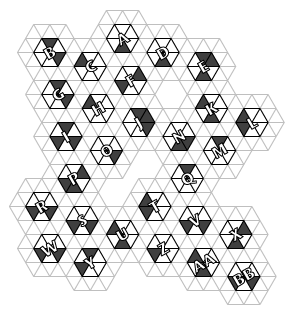
Before I began making more complicated puzzles, I went out and researched other puzzles which I found compelling. One collection of puzzles I still find fascinating is "Mad Mazes" by Robert Abbott (which I believe is out of print, but can still be found in used bookstores). In that book were two puzzles about a pair of astronauts that had to cooperate to escape a diabolical set of rooms and passageways. The movements of the one astronaut affected the possible movements of the other.
These two puzzles provided the underlying concept for the Double Jumping puzzles. They were the very first type of puzzle I had ever made where the physical problem space gave little indication of the actual problem space. In a normal maze, the state of the problem (how far along you are in solving it) is directly represented by your physical location. That's no longer true here. One player could be on a hexagon, but their distance to the goal is dependent upon the location of the other player. A player could return to a particular hexagon many times over the course of solving the puzzle, while advancing the other player. These types of movements violate a basic problem solving schema, that the closer you are physically to the finish line, the closer you are to solving the puzzle. This makes the Double Jumping puzzles more challenging than most mazes.
This mismatch between the problem space and the physical problem space required, for the first time in my puzzle-making experience, mapping out the entire problem space for each puzzle . The dead ends of a normal maze are simple to identify, for they are the places where the path physically ends. In the Double Jumping puzzles, they are much harder to recognize. One player could be on a hexagon, but their ability to move forward in the puzzle is dependent upon where the other player is. When constructing the Double Jumping puzzles, I tried to keep an overall picture of the solution and dead ends in my mind, but it was simply not possible to get the complete picture without charting out the entire problem space. More often than not, new dead ends and solutions would appear that I had not anticpated. I would then have to make a choice: either restructure the puzzle to embrace the new paths, or trim the puzzle to eliminate them. Sometimes, unintended solutions were more interesting than what I had originally dreamed up. Almost always, the dead ends were more interesting than the actual solution.
Below is the problem space for the first Double Jumping puzzle. The solution is highlighted in blue, while loops are denoted by a vertical dotted line. Notice that the problem space is both long and contains a lot of branches. Both elevate the difficulty of puzzles in general, and in concert, make this first Double Jumping puzzle quite difficult.
Last updated: January 2, 2003
Copyright © 2000-2003 All Rights Reserved